Sir Henry Fishbourne
The PeripheralSir Henry Fishbourne is the City Remembrancer whose arrival exposes how civic authority and investment interests have become entangled with Hamed al-Habib’s exploitation of the island. His sudden death, arranged by Ainsley Lowbeer, shifts influence far enough to bring about Homeland Security’s withdrawal, turning a seemingly local confrontation into a decisive political reversal.
Identity and Arrival
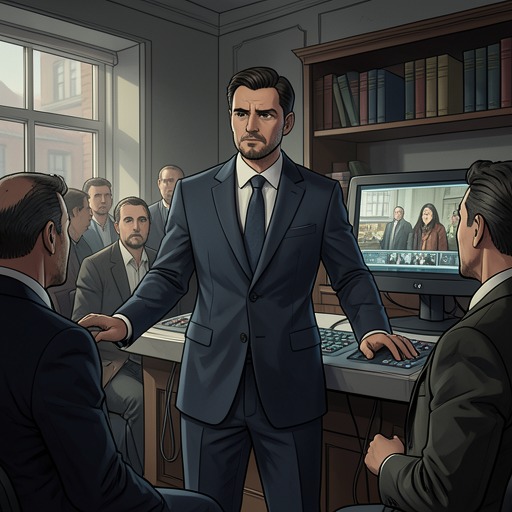
Sir Henry enters a tense encounter in which Wilf Netherton is restrained, Daedra West is present, and Flynne Fisher is being treated as the young woman at the center of the dispute. His entrance is announced by a mellow, tired voice asking Hamed whether the situation has been properly sorted out. Netherton recognizes the speaker as Sir Henry Fishbourne, the City Remembrancer, and regrets identifying him aloud.
The Remembrancer is described as a tall, sturdy older man dressed in elaborate Cheapside cosplay, carrying a top hat. The theatrical costume makes him look like an official embodiment of the City’s past, but his immediate concern is contemporary power: he tells Hamed that he needs to leave so he can confirm a successful result to their investors. He also comments on Flynne’s worn appearance, treating the encounter as a long day’s business rather than as a crisis for the people caught in it.
Business with Hamed al-Habib
Sir Henry’s connection to Hamed is more than a casual acquaintance. Hamed explains that his public persona is a form of branding: he represents the product and is known to the investors. When pressed on what the product is, he describes it as the monetization of the island he created. The exchange places Sir Henry within an investment scheme built around the island and raises the question of whether it belongs to Hamed alone or to the patchers as well.
Hamed answers that the patchers have endemic health issues of which they are not yet aware. Sir Henry’s presence as a City official, his investor-facing role, and Hamed’s language about monetization frame the island not as a shared home but as an asset to be developed and exploited. The scene does not spell out the precise terms of Sir Henry’s involvement, but Lowbeer later characterizes his willingness to deal with someone like Hamed as a grave political and moral choice.
Judgment and Death
After Sir Henry arrives, Lowbeer tells him that his successor will be Marchmont-Sememov, his longtime rival and chief thorn in his side. She acknowledges that he had seemed to manage his awkward position well until the present revelation, then confronts him with the substance of the alleged arrangement: a real-estate and development scheme involving resource extraction, pursued through dealings with Hamed al-Habib.
Lowbeer has already acted against Sir Henry. She explains that, on his arrival that evening, she assumed he would prove guilty and took the liberty of causing his death immediately. The violence is carried out through the exoskeleton: its wrist hatches reveal a candy-cane gun and Lowbeer’s gilt, fluted-ivory tipstaff, and the tall man is reduced to bone. His clothes fall empty to the floor and his top hat rolls in a circle. The abrupt physical destruction gives concrete force to the political decision that preceded it.
Political Consequences
Lowbeer describes Sir Henry’s death as depriving Flynne’s competitor of the kind of advantage that Lev Zubov and Lowbeer provide to Flynne’s side. His removal shifts influence, with the immediate consequence that Homeland Security withdraws and its orders are rescinded. Sir Henry is therefore not merely an investor or a compromised official: in Lowbeer’s account, his position is part of the leverage keeping a lethal state action in play.
Flynne responds by asking what had to be bought to produce that result. Lowbeer says she believes a sufficient share of Hefty Mart’s parent corporation was involved, though she has not yet received the details. That answer places Sir Henry’s fall within a larger contest over corporate and political influence. The scene links an investment scheme around the island to a countervailing purchase whose effect is to stop the Homeland Security operation, while leaving the mechanics of the transaction partly unresolved.
Narrative Role
Sir Henry appears briefly, but his arrival changes the meaning of the confrontation. Netherton’s recognition gives him institutional weight; his concern for reporting a successful outcome to investors reveals the commercial network behind the gathering; and Lowbeer’s accusation turns that network into grounds for immediate judgment. His elaborate costume and formal title contrast with the stark outcome of the scene: a civic authority who arrives to certify a result is dead before he can leave, and the balance of power changes with him.
The episode also places two kinds of political action side by side. Sir Henry’s association with Hamed’s island scheme represents influence exercised through investment and development, while Lowbeer counters it with a targeted killing and a shift in corporate leverage. The resulting withdrawal of Homeland Security’s orders is consequential, but the scene does not present the new balance as independent of coercion or wealth. Sir Henry’s brief role thus helps expose the machinery through which apparently respectable authority, private capital, and state force converge.